|
7. |
IN WATER IMMERSION TECHNIQUE, ONE-PATTERN INSERTION IS POSSIBLE |
IN EARLY SHORTENING THERE IS
NO DIFFERENCE BETWEEN ALPHA AND REVERSED ALPHA
During Water Immersion Technique the colon is deflated and not shortening-resistant. With the tip hooking in the former half of the sigmoid colon and repetitive small shortening movements, the loop ahead of the scope will be dissolved. Thus, there will not be much difference between alpha-loop and reversed-alpha-loop and the insertion can be carried out same way.
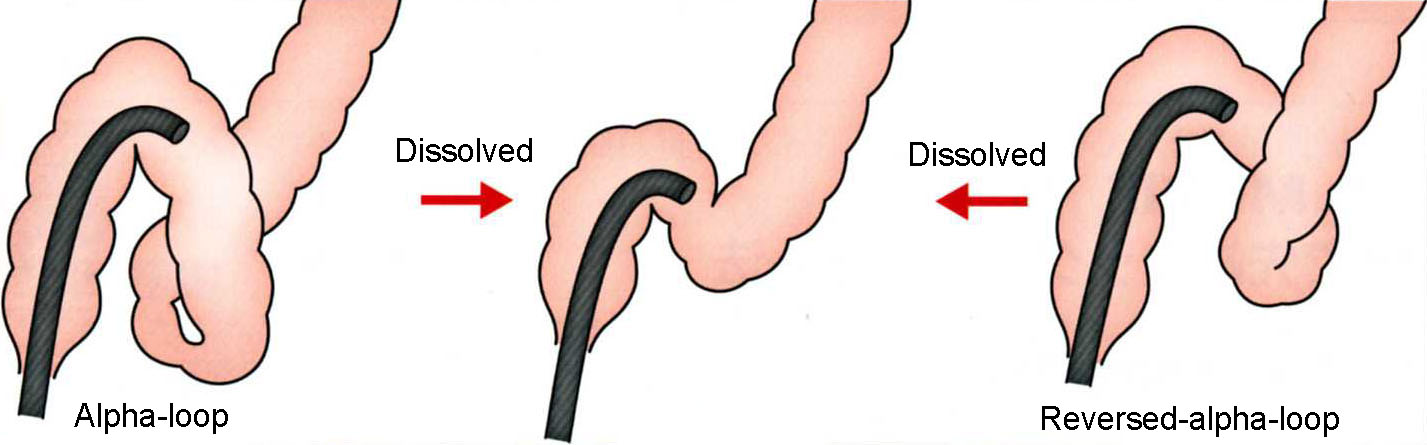
[INSET 7-1] With early shortening the same insertion maneuver can be used both for alpha-loop and reversed-alpha-loop. |
EVEN FOR TORTUOUS COLON
ONE-PATTERN-INSERTION TECHNIQUE IS EFFECTIVE
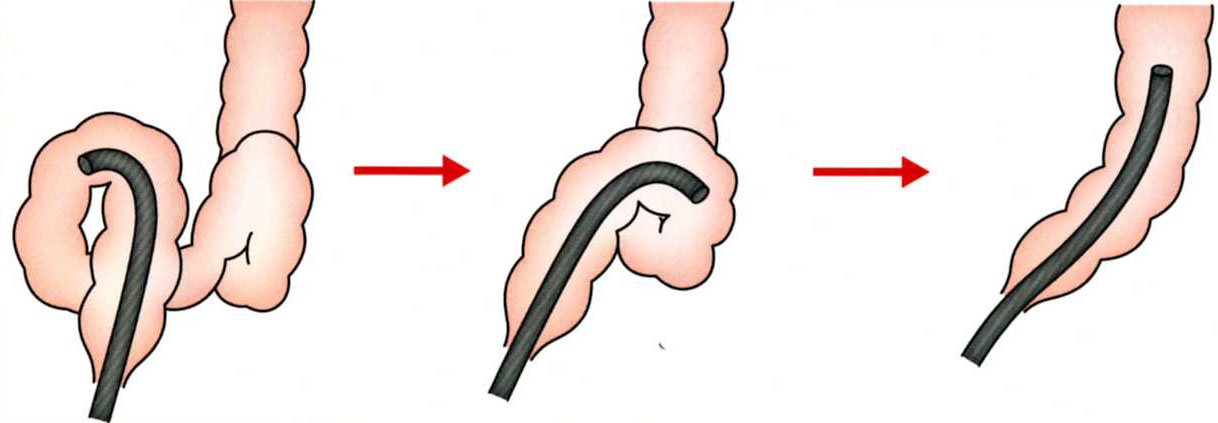
The colon we see in the double contrast enema is an elongated colon, while the original colon is deflated and shortened. It is artificially elongated by pushing the scope and insufflated air. With Water Immersion Technique, the colon will not be elongated and early shortening with tip-hooking can dissolve the loop ahead before the tip of scope reaches the tortuosity. Unlike the colon model, a human's colon varies a great deal, however, though early shortening can make all those different shapes into one pattern. Even the most tortuous colon only needs extra shortening. In other words, when you passively insert the scope just as the lumen develops, the colon appears much different from person to person, while when you actively perform early shortening and restructure the colon to the pattern of the colon model, the insertion could be always the same regardless of the initial shape of the colon.
|
[MOVIE 7-1] SUMMARY OF WATER IMMERSION TECHNIQUE IN 1 MINUTE Water Immersion Technique is a painless insertion technique and easy to master. It might not be the fastest method, however, though it has fewer time-consuming cases. The original colon is rather straight, so if you do not elongate it and start shortening at an earlier point, you have a better chance of achieving the successful cecal intubation without forming a loop. It is crucial to prepare a water pump and a tip attachment, select the right fiberscope, and change the stiffness of the scope well. Change the way of holding the scope and practice 1000 times with a colon model, and when you can reach cecum in 1 minute with the model, it will take you 10 minutes with a real human colon. |
ADVICE FOR EXPERIECED
ENDOSCOPISTS
Water Immersion Technique is easier to master for complete beginners than for doctors with colonoscopy experience. Endoscopists who have experience with air insufflation technique use too much water. They tend to move the scope too much and too fast. They tend to give up pulling the scope too easily and push the scope. During Water Immersion Technique, the colon is deflated so it might feel more difficult to find the direction, but once you are accustomed to the view it feels easier to make an advancement.
|
TALKING POINTS: SEVEN PIECES OF ADVICE FOR EXPERIENCED ENDOSCOPISTS 1. Do not use too much water-use only small amount of water so that the colon stays collapsed. |